

How to Check and Withdraw BISP 13,500 Installment in 2026 Using CNIC Thumb Verification
The Rs 13,500 installment of the BISP is a vital financial help program to help low-income families pay more to survive in 2026. The CNIC is encrypted and the thumb verification method makes it possible for beneficiaries to immediately see their payment status and withdraw funds without fraud. Check and Withdraw BISP 13500; this process is transparent so that the help is directed to eligible individuals, especially women in households. When you know how to verify and collect the payment, it saves time and avoids common issues. This guide will outline each step of withdrawal so you can make sure that it goes smoothly.
Read More: BISP 8171 January 2026 Latest Payment: How to Check CNIC & Get Wallet Transfer Details
Eligibility Criteria for BISP Beneficiaries in 2026
1. Low-Income Households
Families below the poverty threshold identified through the PSER / NSER survey may be eligible for BISP help. Qualification depends on household income and living conditions.
2. Valid CNIC Holder
The applicant must have a valid and active NADRA CNIC. Any unused, blocked, or canceled CNICs are not accepted for payment or verification.
3. Women as Registered Beneficiaries
BISP payments are distributed in the name of women, preferably the head of the household, in order to promote financial inclusion and household stability.
4. Biometric (Thumb) Verification Clearance
The eligibility requirement is the successful thumb verification at the time of payment collection. Beneficiaries with biometric discrepancies must update their records at NADRA.
5. Poverty Score Compliance
Homes must fall within the range of poverty suggested by BISP. Families who exceed the threshold are excluded from participating.
6. No Government Employment
Applicants or their spouses are not government employees (other than lower-grade workers as BISP policy states).
7. No Major Assets Ownership
Large family landholdings, commercial property, or registered businesses are not considered part of the program.
8. Active Mobile SIM on CNIC
Payment alerts and digital wallet integration require a valid mobile SIM with data stored on the beneficiary’s CNIC.
Read More: BISP January 14,500 Payment Eligibility Check & Collection Guide 2026
Ways to Check Your Rs 13,500 BISP Payment Status
1. Via 8171 SMS Service
- Your CNIC without dashes to send to 8171.
- An SMS will send you confirmation of your eligibility and payment status.
- It is free and available to all mobile networks.
2. Through the BISP Official Website
- Visit the BISP payment portal.
- Click here to check your status online using your CNIC number and captcha code.
- The portal provides the date and payment modes to be shown.
3. Using the BISP Mobile App
- Download the official BISP mobile app on your smartphone.
- Log in using your CNIC number and registered mobile number.
- View payment history, upcoming installments, and wallet balance if using digital payments.
4. At Designated BISP Centers
- Visit any BISP office or partner bank.
- Please inform your CNIC of the last installment.
Read More: BISP 8171 Payment Tracking 2026: How to Check CNIC Eligibility Online
Importance of CNIC Verification in the BISP Payment System
1. Ensures Accurate Beneficiary Identification
CNIC verification is done in order to ensure the identity of each applicant so that the Rs 13,500 payment is only given to those who qualify. It also prevents mistaken names or duplicate entries.
2. Prevents Fraud and Misuse
By linking payments with a single CNIC, BISP reduces the potential for fraudulent claims, unauthorized withdrawals, and identity theft.
3. Facilitates Digital Wallet Integration
CNIC verification is important for connecting beneficiaries to digital wallets and allows for secure online payment and withdrawal.
4. Streamlines Payment Distribution
It allows BISP to monitor and manage funds in a timely manner, making payments less time-consuming and expediting payments at payment centers.
5. Compliance with Government Regulations
Linking payments to a registered CNIC ensures accountability and compliance with national financial and social protection regulations at all times.
6. Enables Biometric Verification
CNIC verification is a condition for thumb (biometric) verification necessary to pay securely at authorized centers.
Why Biometric (Thumb) Verification Is Required for Payment Withdrawal
BISP withdrawal requires biometric (thumb) verification to make sure the right beneficiary receives the Rs 13,500 Qist safely. The combination of payment and CNIC and unique thumb impression is further secure against fraud and fraudulent withdrawals.
This verification is also relevant for recipients who have digital wallets, and it facilitates transactions and ensures account security. It also reduces errors at the payment centers and ensures timely and precise payment in accordance with government regulations, while maintaining transparency and accountability in the BISP payment system.
Understanding Wallet SIM Integration for BISP Payments
Integration of a wallet SIM is an important first step toward modernizing BISP payments as the recipient’s mobile number can be linked to their digital wallet account. All registered SIMs have to be active and checked against the CNIC of the beneficiary in order to perform safe transactions. This means BISP can send payment notifications, transaction alerts and installment updates directly to the beneficiary’s phone, making the process of sending payments transparent and convenient.
It also allows beneficiaries to electronically send or receive funds through authorized agents or partner banks eliminating physical cash handling. BISP connects the wallet to a verified SIM and is able to improve the security, efficiency and accessibility of its financial support programs.
Complete Withdrawal Process at Authorized BISP Payment Centers
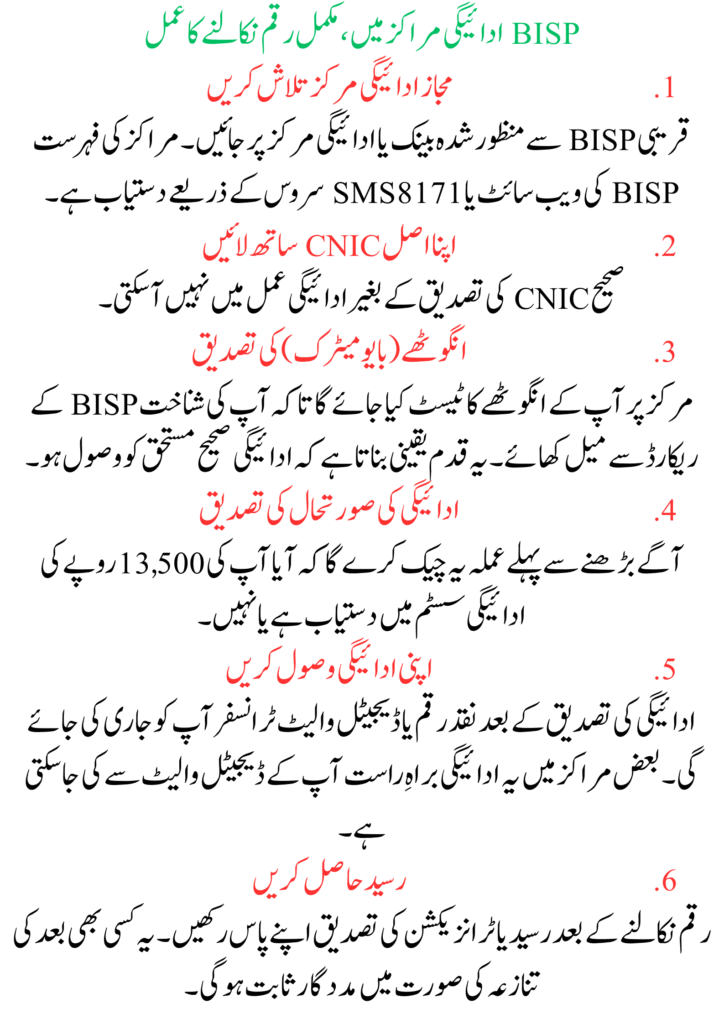
1. Find an Authorized Payment Center
Visit a nearby BISP-approved bank or payment center. The center list is available on the BISP website or via the 8171 SMS app.
2. Bring Your Original CNIC
The payment cannot be processed without proper CNIC verification.
3. Thumb (Biometric) Verification
At the center, a test of your thumb is conducted to validate your identity against BISP documents. This step ensures that the payment is taken by the correct beneficiary.
4. Confirmation of Payment Status
Before proceeding, the staff will check to see if your Rs 13,500 payment is available in the system.
5. Receive Your Payment
The cash or digital wallet transfer will be released to you once your payment has been confirmed. Some centers may charge you directly from your digital wallet.
6. Send a Receipt
Take a receipt or transaction confirmation with you after withdrawing to keep on file. This helps in case of any later conflict.
Benefits of Receiving BISP Payments Through Digital Wallets
1. Convenience and Accessibility
Funds can be used at any time and anywhere without traveling far to payment centers.
2. Fast Transactions
Digital wallet payments are transferred in minutes, reducing waits as compared to cash disbursements.
3. Enhanced Security
Protection Enhanced Digital wallets resist theft or loss of cash by encrypting transactions with CNIC and thumb verification.
4. Easy Record Keeping
Beneficiaries can view payment history, balance, and transactions from their wallet, making it easier to stay organized in their finances.
5. Direct Transfer to Bank Accounts
Virtual Transfer to Bank Accounts Digital wallets often allow for seamless transfer to linked bank accounts with the benefit of flexibility in household budgeting and expenditure.
7. Support for Women’s Financial Inclusion
Payments made electronically empower women with greater control over household finances and decision-making.
8. Reduced Errors and Fraud
Linking payments to verified wallets ensures accurate, authorized payments, reducing manual errors in payment centers.
Common Payment Issues and Solutions
1. Payment Not Received
Sometimes the payment does not arrive due to a system delay or incorrect verification. See if you are still eligible by calling 8171 SMS, or visiting the BISP portal or mobile app, or even going to the payment center.
2. Problems with CNICs
If your CNIC has expired, been blocked, or was not linked to BISP records, payment cannot be processed. Then update or activate your CNIC at NADRA to help resolve this issue.
3. Thumb Verification Is Unread or Missed
A mismatched thumb impression could prevent withdrawal. Re-enter your biometric data at an authorized BISP center or NADRA office.
4. Issues with SIM or Wallet.
A deactivated or unconnected SIM can stop digital wallet transactions. Make sure your SIM is active, registered on your CNIC, and linked to your wallet.
5. Payment Center error
Technical issues or network issues can cause problems at the center. Try again later or go to another BISP center that is authorized.
6. Irregular Payment Amount
Sometimes, incorrect payment is the result of wrong data entry. Report the problem to the BISP helpline or the nearest office for correction.
Safety and Security Guidelines for BISP Beneficiaries
1. Keep CNIC Safe
Carry your original CNIC and never share it with anyone. Your CNIC is needed for verification and payment collection.
2. Protect Thumb Verification Data
Strict payment security is provided by thumb (biometric) verification. Don’t let anyone use your thumb for collection.
3. Use Authorized Payment Centers Only
Collect payments only from approved BISP banks or centers to avoid fraud and scams.
4. Stay Alert Against Fraud
To Avoid Fraud Ignore calls, messages or agents who are willing to pay for the service. BISP payments are free and official.
6. Monitor Digital Wallets Carefully
If you are using a digital wallet, check your transactions regularly and ensure your mobile SIM is safe.
7. Gather Receipt or Confirmation
Always get a receipt or transaction slip after a withdrawal in order to avoid any disputes that might arise.
8. Report Issues Quickly
If payment was wrong, lost or stolen funds are found, immediately dial the BISP helpline or go to the nearest office.
Read More: BISP Fraud Protection Guide 2026: How to Stay Safe & Secure Your Payments
Conclusion
BISP Rs 13,500 installment will benefit families with low incomes in 2026 and will offer relief and stability to the household. Beneficiaries can receive their payments in a safe and timely fashion by following the proper CNIC and thumb verification procedures. The online wallet and authorized payment centers make the process convenient, safe and efficient. Knowing what’s going on and having the safety measures in place helps beneficiaries avoid delays and fraud. With these steps families can confidently use their BISP resources and fully exploit this government assistance program.
FAQs
How can I know if I can claim my Rs 13,500 BISP installment?
You can check your eligibility by sending your CNIC (no dashes) to 8171 via SMS, or by visiting the BISP official site or mobile app.
Do I need a mobile wallet to receive the payment?
Digital wallets can be used to collect payments with cash at authorized locations, but money can be obtained more easily and safely and conveniently using them. MasterCard needs to be charged through a working SIM that is associated with your CNIC.
What if my payment is not coming in at the center?
Check your credit card status on 8171 SMS, BISP portal, or mobile app. If it still doesn’t show up, report it to the nearest authorized BISP center.
How do I report BISP payments?
If you have questions or need help, you can call the BISP helpline or visit the nearest authorized BISP office.